Violinist Daniel Matejča and accordionist Martin Šulc have recorded Piazzolla with passion and freedom
18. 6. 2026 — News

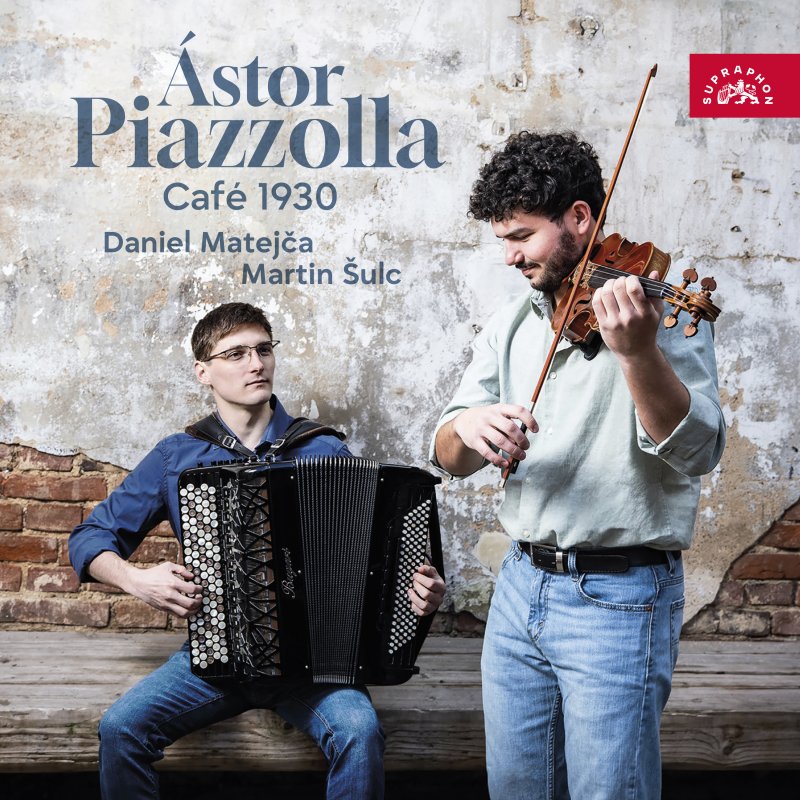
At just 21 years old, violinist Daniel Matejča is one of the most distinctive figures of the rising generation. His playing combines technical mastery with natural musicality and the ability to freely cross genre boundaries – and it is precisely this openness that his new album confirms. The fourth release in his Supraphon discography, Piazzolla – Café 1930, brings a significant stylistic shift. Following the virtuoso sonatas of Eugène Ysaÿe, a chamber album with pianist Jan Schulmeister, and orchestral projects with the Prague Radio Symphony Orchestra conducted by Tomáš Netopil, he now turns to Ástor Piazzolla’s tango nuevo – music situated at the intersection of classical, jazz, and Johann Sebastian Bach, and spanning Buenos Aires, Paris, and New York. The album Piazzolla – Café 1930, which Daniel Matejča recorded with accordionist Martin Šulc, will be released on June 19, 2026, on CD and in digital formats.
Daniel Matejča made a name for himself on the international scene by winning Eurovision Young Musicians 2022 and achieving success in competitions such as Virtuosos V4+, the Telemann Competition, and the Kocian International Competition. Martin Šulc (*2001), who studies at the Hochschule für Musik in Trossingen, is a laureate of numerous international competitions and the winner of Virtuosos V4+, and he regularly performs at prestigious festivals.
On the album Piazzolla – Café 1930, Matejča and Šulc create a sonic world full of contrasts – ranging from gentle, intimate passages to an almost orchestral richness. Their interpretation is characterized not only by perfect ensemble playing but also by a distinctive degree of freedom and individuality. “Piazzolla’s music is so straightforward that it invites immediate, sincere expression,” says Matejča.
In addition to the two larger works, Suite del Ángel and Histoire du Tango, the album’s program also features iconic compositions such as Ave Maria, Oblivion, Escualo, and Finale. It is precisely in these pieces that the breadth of Piazzolla’s musical language is fully revealed – from lyricism to rhythmic energy.
For Daniel Matejča himself, Piazzolla’s music also has a personal dimension. “Perhaps that is precisely why it holds special value for me – that I was now able to give it my own voice,” he adds regarding his interpretive approach.
The album Piazzolla – Café 1930 thus represents not only another step in Daniel Matejča’s rapidly developing career, but also a personal statement by two young performers who find in the Argentine composer’s music a space for contemporary, free interpretation.
SUPRAPHON a.s. hereby expressly reserves, pursuant to Section 39c(2) of Act No. 121/2000 Coll., the Copyright Act (implementing Article 4(3) of Directive (EU) 2019/790), all rights in respect of all its protected works, in particular literary works, musical works, sound recordings, audiovisual recordings, graphic works and works of fine art, including any reproductions and derivative works thereof, against their use for the purposes of automated text and data mining in digital form (TDM – text and data mining).