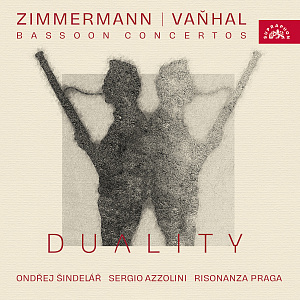
ONDŘEJ ŠINDELÁŘ AND SERGIO AZZOLINI
ON A REMARKABLE ALBUM DUALITY
Album detail
Catalogue number: SU 4375-2
12th February 2026
The bassoon as a solo instrument does not appear all that often in the concerto literature, but a concerto for two bassoons is truly rare, being something that could arise only in the environment of an ensemble that possessed two soloists on that instrument. One such double concerto has been played for many years under the name of the important Czech composer Jan Křtitel Vaňhal. But what if it had really been composed by someone else? The question has been raised by Ondřej Šindelář, a player of the classical bassoon, who has found the same concerto bearing the name of Anton Zimmermann in one of Prague’s archives. The two works differ from each other only in the slow movement. Theft? Plagiarism? A copyist’s error? Collegial assistance? This musical mystery adds a unique tension to the project. The album will be released on 20th February on CD and in digital formats.
On the new album Duality, Ondřej Šindelář, together with his former teacher, the world-renowned bassoonist and conductor Sergio Azzolini, recorded the world premiere of Zimmermann's version of the double concerto. The recording is further complemented by Zimmermann's solo Concerto in F major (also a world premiere) and one of the three surviving bassoon concertos by Jan Křtitel Vaňhal. The project presents remarkable and previously undiscovered music by two composers whose lives intersected in Hradec Králové, Pressburg, Vienna, and other cultural centers of Central Europe. In the hands of experienced soloists and a top-class orchestra, the recording is a true musical feast.
Ondřej Šindelář describes the project: "Sergio Azzolini once mentioned to me another version and the uncertainty surrounding the authorship," says Šindelář. "When I then found a record in František Červenka's bibliography about Zimmermann's manuscript stored in the archives of the Prague Conservatory, the whole detective story began."
The two concertos differ mainly in the middle movement. Zimmermann chooses the form of a melodious duet for two bassoons with a string orchestra, while Vaňhal's instrumentation is much more chamber-like – only for two bassoons, violas, and bass. There are also differences in the scope of the last movement, which is much more balanced in Zimmermann's version compared to the first movement. "It is precisely these subtle differences that I personally find very appealing in Zimmermann's version," adds Ondřej Šindelář.
The recording took place in an exceptionally inspiring atmosphere. "Sergio and I share a common language and a passion for music. We don't usually need to talk much about the details – the music just happens," describes the bassoonist. "For me, it was the experience of a lifetime. A debut, long preparation, and above all, joyful music-making."
Ondřej Šindelář also draws attention to the qualities of Zimmermann, who is little known today. “He is a composer with original ideas and great inventiveness. I think his music is yet to gain a wider audience. Similarly, there is still much to be discovered in the musical heritage of Pressburg.”