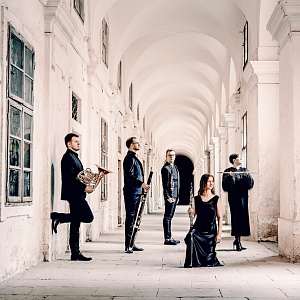
ALINDE QUINTET
MUSIC AS AN INSCAPE
Album detail
Catalogue number: SU 4373-2
8th December 2025
Winners of the prestigious ARD Competition in Munich in 2024 and laureates of the Carl Nielsen International Competition in Copenhagen in 2023, the Alinde Quintet is one of the most distinctive phenomena on the European chamber music scene today. These five musicians who play in renowned Czech and foreign orchestras are now coming out with their debut album Inscape. Four compositions by Pavel Haas, Dmitri Shostakovich, Jan Novák, and Pēteris Vasks form a powerful dramaturgical arch from dark reflections on totalitarian regimes to joyous playfulness. Just before the album’s release, we spoke with them about how their own “inscape” came to be.
The title of your debut album is Inscape. What does the word “inscape” mean to you in the context of these four compositions, and how did you approach the works musically?
Each composition that we chose for our debut album reflects its composer’s inner world. Just as each work is unique, the stories of the lives of Haas, Shostakovich, Novák, and Vasks are also unique. This diversity inspired us to do our own searching: we appear as a whole – as a chamber ensemble that jointly creates a new musical landscape, yet each of us has his or her own inscape. In this way we are trying to enrich our shared cultural consciousness.
That is also how we see this album: like looking within us, and an impression of that glimpse, which we hope will also enrich the listeners. It is a warm invitation for them to gaze into their inner world while encountering the inscapes that inspired this music.
Each of the composers on the album has lived through major historical upheavals. As performers, how did you deal with the emotional depth and historical context of these works?
It is the fates of these composers and the circumstances of the creation of their music that give these works their extraordinary depth and communicativeness, and that is why we chose them. Thanks to that, the wind quintet appears in a different light from what is usual. Not merely as a genre of light, playful music, but instead as a full-fledged chamber ensemble with a wide range of expressive possibilities.
After making the recording, we felt not only physical and mental exhaustion, but also deep fulfilment from having created something important, something of broader significance that still resonates today.
The album offers a stark contrast between the dark compositions by Haas, Shostakovich, and Vasks and the playful Concertino by Jan Novák. What was your approach to dramaturgy and the programme order?
We have chosen works that we regard as being of key importance in our repertoire. All four composers were strong personalities who were unafraid to hold firmly to their personal and political beliefs – and one senses this strongly in their music.
Haas wrote his Wind Quintet at age 30 – about our current age. The composition combines youthful energy with deep expression. Moreover, we associate it inseparably with our appearance at the ARD Competition in Munich, where it left a strong impression even on those who had never heard of Haas before.
The concluding Epilogue of that composition ties in naturally with what follows: Shostakovich’s String Quartet No. 8 arranged for wind quintet – a work that the composer himself called a kind of personal epilogue. The work consists of a continuous twenty-minute flow of expressive music that is always a great interpretive challenge for us. We are proud of having been able to make the very first studio recording of this arrangement.
Vasks’s composition Music for a Deceased Friend brings acceptance – of sorrow, solitude, and loss. We enjoy playing contemporary music, and it was a great honour for us to be able to record a work by such an important composer who is still living.
The conclusion of the album belongs to Novák’s Concertino, which evokes his carefree years before his emigration. We think Jan Novák deserves more attention – his music is clever, original, and at the same time approachable. In the context of the album, it offers light and hope, contrasting with the darker moods of the previous compositions. It offers listeners the chance to discover that place within them where joy prevails despite difficulties.
Your arrangement of a string quartet by Shostakovich for wind quintet is very daring. What drew you to this arrangement, and how has the public reception been?
It should be said that the arrangement is by Mark A. Popkin, but we have made some changes of our own to it. Some were purely practical, so that certain passages were easier to play, and others were based on our feel for interpretation. We hope the resulting version best serves the music itself.
Since your victory at the ARD Competition in Munich, you have been called a new star of chamber music. In what artistic direction will you be heading next, and what are your plans after issuing this album?
As our earlier answers probably imply, we care very much about there being more room for wind instruments and wind quintets. Ensembles with strings and piano have a tradition of their own, but the wind quintet offers a different world – one full of colours, contrasts, and personalities. It’s like discovering new cuisine: once it has excited you, you want to keep getting to know it, and soon you can’t imagine your world without it.
We are overjoyed by every opportunity to give a concert, encounter the public, and share music. And if we manage to spread Czech music beyond our country’s borders, that is all the better. Czech composers have written dozens of works for wind quintet that deserve greater attention. In the spring, we will be devoting ourselves to the music of Nordic composers, but in the long term we are planning a project focusing on Czech composers of the latter half of the 20th century—there should be enough material for a multivolume set.
We would also like to pass on our enthusiasm for wind chamber music to the next generation. We have some ideas, but we still want to keep them to ourselves for the moment.